
Turn the Package Around: Nutrition Labels
Turn the Package Around: A Calm Guide to Nutrition Labels
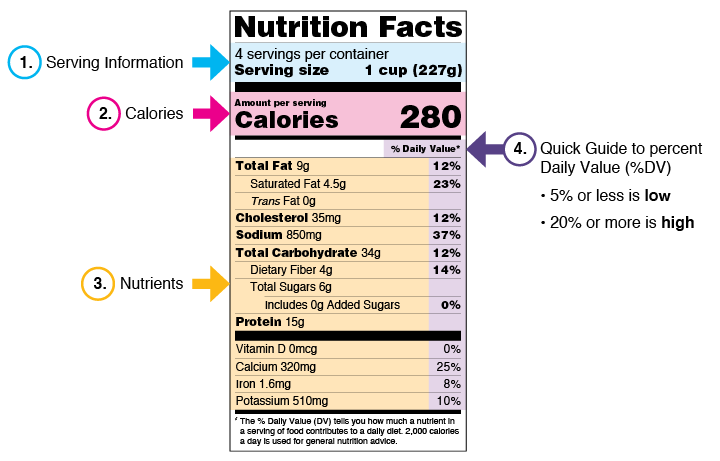
Start with serving information, then use calories, nutrient amounts, and percent Daily Value to answer your shopping question.• U.S. Food and Drug Administration. Public domain
Its usefulness comes from answering a few specific questions about foods you actually buy. Once you learn where to look, comparing two products becomes much easier, and you can leave the rest of the package’s speech-making to itself.
Start at the top, before examining calories or sugar. The serving size tells you the amount of food to which the numbers apply. It reflects what people typically consume and is not advice about how much you personally should eat. Servings per container tells you how many of those amounts the package holds. A package and a serving are sometimes the same thing,ie, one serving pr package. Be aware. [1]
For a clearly hypothetical example, imagine a soup container holding two one-cup servings. Each serving supplies 180 calories and 600 milligrams of sodium. Eat the entire container and you get 360 calories and 1,200 milligrams of sodium. Those who are keeping track of such numbers about calories and salt intake can now decide how much of the can to consume as part of your meal. [1]
Calories measure food energy. They can be useful information, particularly when you are planning meals around personal energy needs, but they do not tell you how much protein, fiber, or calcium a food provides. The 2,000-calorie figure at the bottom of the panel is a general reference, not an assignment issued to every adult. Individual weight and height vary greatly – calorie needs depends many factors including age, body size, and activity. [2]
Next, notice the percentages down the right side. The percent Daily Value, abbreviated %DV, shows how much one serving contributes to a daily reference amount for a nutrient. Think of it as a common measuring scale that helps you compare products. [3]
The FDA offers a useful shortcut: “5% DV or less is low; 20% DV or more is high”, per serving. These guideposts help you spot meaningful amounts without memorizing a small encyclopedia of milligrams. Whether “high” is desirable depends on the nutrient and your needs. FDA generally encourages choosing more dietary fiber, vitamin D, calcium, iron, and potassium, while limiting saturated fat, sodium, and added sugars. [3]
 “What to Eat Now: The Indispensable Guide to Good Food, How to Find It, and Why It Matters by Marion Nestle. Available on Barnes & Noble This nonfiction guide examines American food shopping and the forces shaping supermarket choices, making it a useful companion to a practical article about understanding packages. It offers broader consumer and food-system context. |
Consider sodium, the mineral listed separately from fat and carbohydrate. It is a useful comparison point because similar foods can contain quite different amounts, and a food need not taste especially salty to contribute sodium. The label’s daily reference is 2,300 milligrams; 460 milligrams is therefore 20% of that amount. Look at the portion you expect to eat, especially with soups, sauces, and prepared meals. [4]
Package wording can help you find candidates to buy, but check the numbers too. For example, “reduced sodium” means at least 25% less than the regular product. It does not necessarily mean the result is low in sodium. A reduction from a very high starting point may still leave a substantial amount. Comparing actual amounts gives that useful claim some context. [4]
Fiber offers another straightforward comparison. Put two cereals beside each other and check that their serving amounts match before comparing fiber grams. If one serving is substantially larger, an apparently impressive number may partly reflect more food. The gram weights beside the household measures can help you spot this. Choose a product you enjoy and can afford; and narrow your choices down to the most nutritional value per meal.[2]
Sugar needs a little translation. “Total Sugars” includes both naturally occurring sugars, such as those in milk and fruit, and added sugars. The line beginning “Includes” identifies the added-sugar portion already inside that total. If an illustrative yogurt lists 12 grams of total sugars, including 7 grams of added sugars, it contains 12 grams altogether, not 19. The remaining 5 grams are naturally occurring sugars. [5]
That distinction makes comparisons more useful. Plain yogurt can contain milk sugar even when no sweetener has been added. A sweetened version may contain both. Honey and syrups count as added sugars when used to sweeten foods, despite their reassuring associations with flowers and trees. The label lets you see the amount without needing to the difference between different types of sugar sources. [5]
Keep the whole meal in view as well. Suppose your preferred cereal has less fiber than another brand, but you like it, it is affordable, and you eat it with fruit and yogurt. You can consider what the other foods contribute before deciding whether a switch would help. A food label describes that particular food. It does not know the rest of your normal breakfast, your budget, or what you will actually eat.
Convenience belongs in this calculation. A prepared meal that fits your circumstances may be a useful choice, even if another option has a slightly more favorable number somewhere on its label. Compare foods serving a similar purpose, then consider taste, price, preparation time, and the amount you will actually eat. The goal is to find purchases you can use repeatedly, with fewer surprises that lead you to a healthier diet over time.
Research supports a measured view of what labels accomplish. A 2019 systematic review of 60 intervention studies found that food labeling improved some dietary outcomes overall. However, it combined different label formats and settings, including menus and packaged foods. Those findings support labels as one practical tool for supporting weight changes and oferall health needs. [6]
General reference values also have limits when you have a medical eating plan. With chronic kidney disease, for example, potassium and protein goals may differ from general guidance and depend on your health and treatment. Follow the targets your healthcare team gives you, and ask a registered dietitian which label lines matter most for you. A higher percentage is not automatically an advantage in every circumstance. [7]
Make your next shopping experiment small. Choose two versions of one food you buy regularly, match their serving amounts, and compare the nutrient most relevant to your goal. Then weigh the practical details and make a decision. You can also examine packages at home, where there is better light and no one waiting to reach the crackers behind your elbow. Begin to weed out those products that don’t do the job they should do.
As consumers we need to demand the marketplace serve our needs not just corporate profit margins. Your choices can help develop better quality foods being made available for yourself and for those all around you.
Sources and further reading
FDA references describe current U.S. label guidance; Daily Values are labeling reference amounts, not individualized prescriptions.
1. FDA: Serving Size on the Nutrition Facts Label. Serving amounts, servings per container, and dual-column labels.
2. FDA: How to Understand and Use the Nutrition Facts Label. Food energy, general calorie references, and using the panel.
3. FDA: The Lows and Highs of Percent Daily Value on the Nutrition Facts Label. The 5% and 20% guideposts, product comparisons, and nutrients to emphasize or limit.
4. FDA: Sodium in Your Diet. Sodium reference amount, comparing similar foods, and the meaning of “reduced sodium.”
5. FDA: Added Sugars on the Nutrition Facts Label. Total versus added sugars and interpreting “includes.”
6. Shangguan S, et al.: A Meta-Analysis of Food Labeling Effects on Consumer Diet Behaviors and Industry Practices. “American Journal of Preventive Medicine”, February 2019;56(2):300–314. DOI: 10.1016/j.amepre.2018.09.024. Broad evidence review; it combines multiple labeling approaches and settings.
7. National Kidney Foundation: Reading Nutrition Facts Labels to Make Kidney-Healthy Choices. Updated October 29, 2026. Why personal kidney-care targets can differ from general label reference values.
Comments
Turn the Package Around: Nutrition Labels — No Comments
HTML tags allowed in your comment: <a href="" title=""> <abbr title=""> <acronym title=""> <b> <blockquote cite=""> <cite> <code> <del datetime=""> <em> <i> <q cite=""> <s> <strike> <strong>