
Short Walks for Long Sitting Days
A Short Walk for a Long Day of Sitting
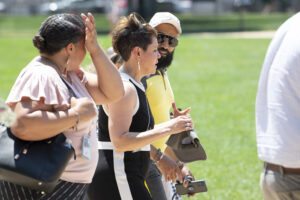
U.S. Department of Agriculture employees take part in a walk-and-talk near the National Mall in Washington, D.C., on June 15, 2022
A walking break fits into that kind of day. It can be a few minutes down the hall, a loop from the bedroom to the kitchen and back, or a trip outside to see what the weather is doing today while your working at your desk. Researchers have tested what happens when people interrupt sitting this way. They’ve also asked a question that matters to anyone spends a lot of time sitting at a job, or at home, or both. How often should people get up and move around and how does it help?
What your muscles do after lunch
 “Built to Move: The Ten Essential Habits to Help You Move Freely and Live Fully” by Kelly Starrett and Juliet Starrett. Available on Barnes & Noble The Starretts offer mobility exercises and ways to fit more movement into ordinary routines, making the book a practical companion to the one-week experiment. The article’s claims about blood sugar draw on the research and clinical guidance below |
In a 2023 experiment, 11 middle-aged and older adults each spent five separate eight-hour days in the lab. One day involved uninterrupted sitting, and the other days included light walking breaks of one or five minutes, repeated every half hour or every hour. Blood sugar normally rises after you eat. The researchers took repeated readings to capture the size and duration of that rise. In this small trial, five-minute walks every half hour were the only schedule that produced a statistically clear reduction in the rise compared with uninterrupted sitting. Duran and colleagues, 2023
A 2026 review pooled results from 39 short lab studies. On average, regular activity breaks modestly reduced the rise in blood sugar and insulin after meals compared with uninterrupted sitting. Walking showed a clearer effect than standing still. The studies measured responses over hours. What this habit alone does for body weight, long-term blood sugar, or disease risk remains uncertain. But reducing the rise of rise oin blood sugar and the overuse of insulin is a worthy goal in itself. Gale and colleagues, 2026.
While being tested in a laboratory you can put a walk on the schedule and keep the afternoon clear. But out in the real world, things are not so easy to coordinate. The meeting that was supposed to end ten minutes ago is still discussing what to discuss next, for example. A study published in 2026 worked with NPR’s “Body Electric” podcast to see how walking breaks would fit into ordinary days. About 19,300 adults signed up and about 11,500 started. They chose to take five-minute walks every 30, 60, or 120 minutes for two weeks. Diaz and colleagues, 2026.
The more frequent breaks were harder to fit in, and the hourly option was the most popular. Participants reported feeling less tired, but they picked their own schedules, rated their own fatigue, and had no comparison group that carried on as usual during the intervention. This a is an anecdotal study which leaves some uncertainty about what caused the positive changes. It does show that even people who volunteered for a walking challenge found that timing mattered. A walk every hour was easier to fit in to the daily routine. “British Journal of Sports Medicine”, study methods and limitations.
How often can you get away?
 Tiny Walkabouts from my desk and go down to the lobby and out the front door, past the potted trees and walk out to the first line of cars and wonder if there will ever be solar panel shading the lot providing energy to the beast nearby, the vast building to which I now return completing the circuit at my desk. At home, I slip out of the door of ©2026 Carl Scott Harker, publisher of 
Western Love Western Magic |
Try it for a week
Pick one stretch when you regularly sit for a long time. Choose an event you can use as a reminder, such as putting your lunch plate in the sink. Take a comfortable two- or three-minute walk before you sit back down. At work, try going to the end of the hallway and back. At home, loops through a few rooms will do. This is a way to see where a walking break can fit in.
If getting up in the middle of a task breaks your concentration, jot down your next action before you leave. “Check the numbers in the last row” will do. When you sit down again, you can pick up the work without reading the whole spreadsheet from the beginning. Keep a sheet of scrap paper handy if that helps.
Give yourself a route for busy or rainy days. A walk to the mailbox can become an indoor loop when the steps are slick. If you work with someone who also wants to move a little more, take a short walk together while you talk through a simple question. When your job ties you to a counter or a headset, use the first gap you can count on, even if it comes later than you’d like. One useful break can fit into an imperfect afternoon.
Choose a way to move that fits your abilities. If you use a wheelchair, a brief roll along a clear route may fit the same spot in your day. If you’re recovering from an injury or surgery, use movements that fit the limits set by your care team. A physical therapist can help you find options if walking or standing is difficult. CDC activity guidance for adults with chronic conditions or disabilities
The American Diabetes Association advises people with diabetes or at risk for it to interrupt prolonged sitting at least every 30 minutes. If you use insulin or a medicine that can cause low blood sugar, such as a sulfonylurea, ask your care team how changes in your activity fit your glucose-monitoring and medication plan. American Diabetes Association, Standards of Care in Diabetes—2026″.
Where short walks fit in a week of activity
For most adults, the CDC recommends at least 150 minutes of moderate aerobic activity a week, 75 minutes of vigorous activity, or an equivalent mix, plus muscle-strengthening activity on at least two days. A brisk walk is often moderate if you can carry on a conversation but would have trouble singing. Three five-minute walks at that effort add 15 minutes to your weekly aerobic total. An easy stroll that keeps your breathing much as it was at the desk is light activity and can still break up a long spell of sitting. CDC adult activity guidance and intensity guide.
At the end of the week, see which reminder got you moving on the days you were busiest. If lunch worked, keep that walk and try a second one after a long morning stretch. If the reminder kept going off while you were on the phone, move the walk to the end of the call. Give it a place in the day and a destination you can reach in a minute. The email will still be there when you get back.
Sources and further reading
– Gale and colleagues, “Obesity Reviews”, 2026. Systematic review of activity breaks and post-meal blood sugar and insulin
– Duran and colleagues, “Medicine & Science in Sports & Exercise”, 2023. Randomized crossover trial of light walking breaks
– Richter, Bilan, and Klip, *Physiological Reviews*, 2025. Review of muscle glucose uptake
– Diaz and colleagues, “British Journal of Sports Medicine”, 2026. Two-week Body Electric walking-break study
– American Diabetes Association, “Standards of Care in Diabetes—2026”. Physical activity and medication precautions
– U.S. physical activity guidance, checked November 12, 2026. CDC adult activity recommendations and federal guidelines Q&A
Comments
Short Walks for Long Sitting Days — No Comments
HTML tags allowed in your comment: <a href="" title=""> <abbr title=""> <acronym title=""> <b> <blockquote cite=""> <cite> <code> <del datetime=""> <em> <i> <q cite=""> <s> <strike> <strong>